Accessing the Companion Groups Directory
To access the Companion Groups Directory, click the Companion
Groups button in the Directory Editors group on the Directory ribbon.
You will need permission to the Companion
Groups Directory in order to access it.
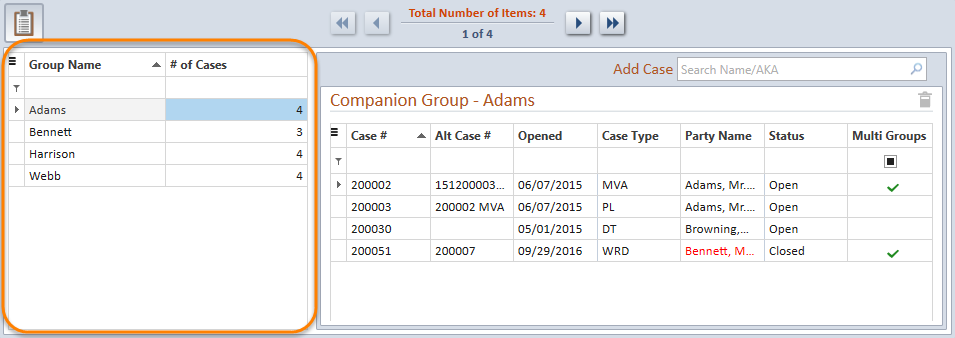
The Companion Groups Directory window displays two panes:
Groups Pane
The Groups Pane is located on the left side of the Companion Groups
Directory window and displays a grid
listing companion groups and the number of case members in each group.
Select a Group Name from the grid to view the list of members in the Group
Members Pane to the right. The Groups grid can be filtered,
searched,
printed
or exported by clicking the hamburger  icon in the upper left corner and selecting the appropriate option from
the menu. Once a group is selected in the Groups Pane, the header bar
displays with available options and the companion cases in the group are
displayed in the Group Members Pane on the right.
Group Members Pane
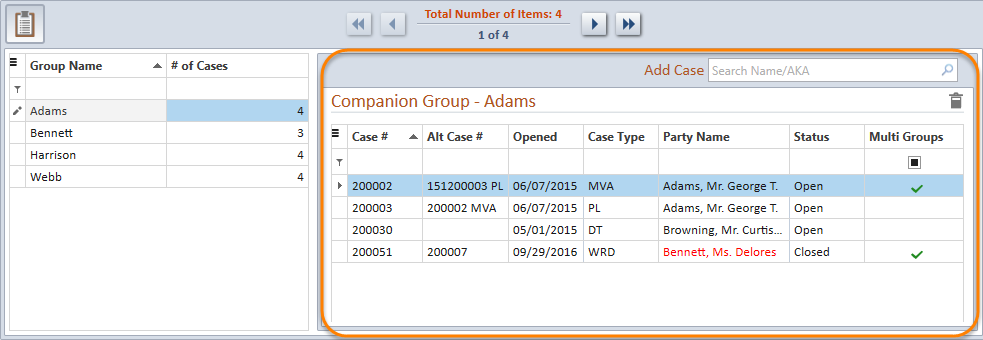
The right-hand pane shows a grid
listing case members in a selected Companion Group. The name of the currently
selected Companion Group will be displayed above the grid. Columns for
identifying case details include Case #, Alt Case #, Opened, Case Type,
Party Name, Status, and Multiple Groups. The Multi Groups column displays
an indicator icon  if a case is a member of other Companion
Groups. Click on the grid's hamburger menu
 to filter
or search
the list of cases in a Companion Group. Columns can be rearranged and
the layout can be saved or reset. The current grid view can be printed
or exported. Double-clicking on a case row in the Group Members list will
open the selected companion case.
Cases can be added
to a group, as well as removed
from a group. Companion Groups can also be created
and deleted
from the Companion Groups Directory.